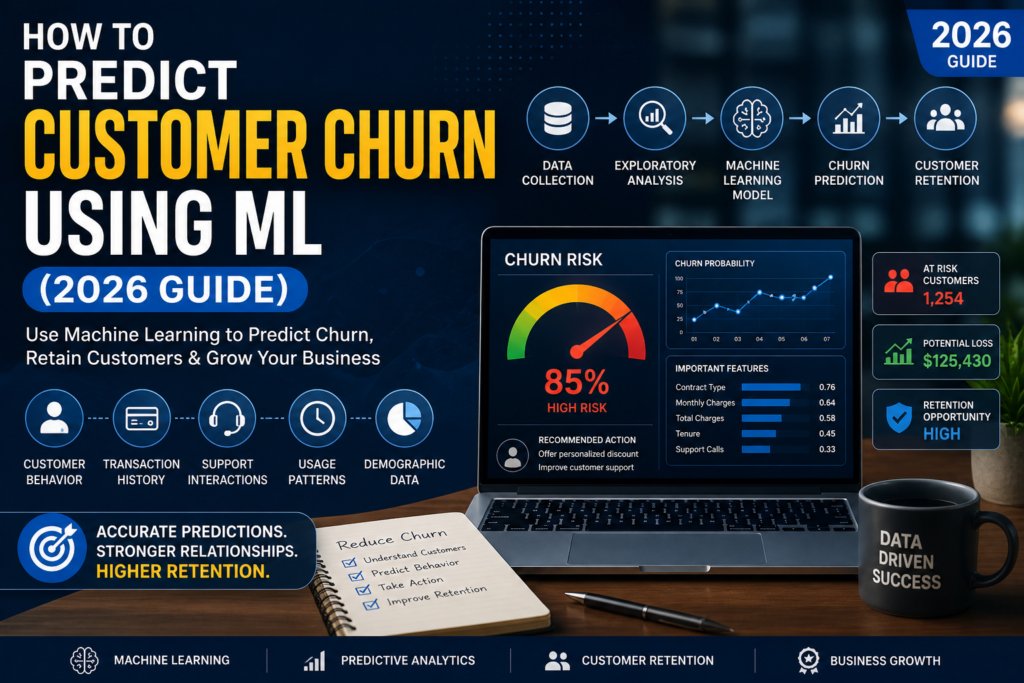
How to Predict Customer Churn Using ML — A Complete 2026 Guide
Losing a customer is expensive. Acquiring a new one costs 5 to 7 times more than retaining an existing one. Yet most businesses only notice a customer has left after the damage is already done.
That’s where Machine Learning (ML) changes everything. Instead of reacting to churn, you can now predict it — days or even weeks before a customer decides to walk away.
In this guide, we break down exactly how to predict customer churn using ML, which tools and algorithms work best, and how businesses across India are combining AI models with WhatsApp chatbot development to keep customers engaged and loyal — automatically.
📊 Why Churn Prediction Matters
5–7x
More expensive to acquire vs retain a customer
67%
Of churn is preventable with early intervention
25%+
Revenue increase from just 5% better retention
What Is Customer Churn — and Why Should You Care?
Customer churn — also called customer attrition — is when a customer stops buying from you, cancels their subscription, or simply goes to a competitor without saying a word.
Every business experiences it. But businesses that measure and predict churn consistently outperform those that don’t. They spot warning signs early — declining purchase frequency, reduced engagement, unanswered follow-up messages — and act before it’s too late.
With the right AI chatbot services India and ML models in place, you can automate both the prediction and the response — turning a potential loss into a loyalty opportunity.
Key Warning Signs That a Customer Is About to Churn
Before you build a model, you need to understand what data signals churn. ML algorithms are trained to detect patterns in these behaviours:
📉
Declining Purchase Frequency
A customer who used to buy weekly now buys monthly — and then not at all. ML flags this trend early.
🔕
Ignoring Messages & Emails
When open rates and reply rates drop to zero, it’s a strong churn signal that automated re-engagement should trigger.
⭐
Low Satisfaction Scores
Customers who rate your service 3/5 or lower are significantly more likely to churn within 90 days without follow-up.
🛒
Abandoned Carts or Sessions
Repeated browsing without purchasing is a classic pre-churn signal — especially in e-commerce and SaaS businesses.
📞
Increased Support Complaints
A spike in complaints, especially unresolved ones, precedes churn in over 70% of cases across service industries.
🔄
Reduced Product Usage
For SaaS and subscription businesses, a drop in logins or feature usage is one of the most reliable early-churn indicators.
How Machine Learning Predicts Customer Churn — Step by Step
Building a churn prediction model isn’t magic — it follows a clear, repeatable process. Here’s how a professional machine learning company like AI Company Mohali approaches it:
Data Collection & Integration
We gather data from all customer touchpoints — purchase history, WhatsApp message interactions, support tickets, website behavior, and CRM records. The more complete the data, the more accurate the model.
Data Cleaning & Feature Engineering
Raw data is messy. We clean duplicates, fill gaps, and create meaningful features — like “days since last purchase,” “support tickets this month,” and “WhatsApp response rate” — that the ML model can learn from effectively.
Model Selection & Training
We test several algorithms — including Random Forest, XGBoost, and Logistic Regression — and train them on your historical churn data. Each model learns which combination of signals best predicts who will leave.
Model Evaluation & Tuning
We test accuracy using metrics like precision, recall, and AUC-ROC scores. The model is fine-tuned until it consistently identifies at-risk customers with 80–90%+ accuracy before they churn.
Deployment & Real-Time Scoring
The model goes live — scoring every customer daily or in real time. High-risk customers are flagged automatically and pushed to your CRM or business automation chatbot for immediate action.
Automated WhatsApp Re-Engagement
Once a customer is flagged as high-risk, a WhatsApp chatbot automatically sends a personalized retention message — a special offer, a check-in, or a satisfaction survey — before they ever think about leaving.
Best ML Algorithms for Customer Churn Prediction
Choosing the right algorithm matters. Here’s a quick comparison of the most commonly used approaches:
| Algorithm | Best For | Accuracy | Complexity |
|---|---|---|---|
| Logistic Regression | Simple, interpretable churn models | Moderate (70–78%) | Low |
| Random Forest | Balanced accuracy + explainability | High (82–88%) | Medium |
| XGBoost | Large datasets, high precision needed | Very High (85–92%) | Medium–High |
| Neural Networks | Complex patterns in big data | Very High (88–94%) | High |
| Decision Trees | Easy to visualize for stakeholders | Moderate (72–80%) | Low |
Why WhatsApp Is the Most Powerful Churn Retention Channel
Your ML model can predict churn perfectly — but if you can’t reach the customer in time, the prediction is useless.
WhatsApp has a 98% open rate. Compare that to email at 20–25%. When your churn model flags a high-risk customer, the last thing you want is a message sitting unread in their spam folder.
That’s why the most effective churn prevention systems combine ML prediction with WhatsApp marketing automation — using the official WhatsApp Business platform to send personalized, timely retention messages the moment a customer enters the danger zone.
Here’s how a combined ML + WhatsApp retention flow works in practice:
🔍
ML Flags Risk
Customer scored as high churn-risk by ML model
⚙️
Automation Triggers
Business automation chatbot initiates retention flow
💬
WhatsApp Message Sent
Personalized offer or check-in delivered instantly
🤖
AI Chatbot Responds
AI customer support chatbot handles replies 24/7
💎
Offer Redeemed
Customer converts — churn prevented
📊
Model Learns
Outcome fed back — model improves over time
Why Businesses in Mohali Need ML-Powered Churn Prevention Now
Mohali’s business landscape is increasingly competitive. Whether you run a real estate agency, an education centre, a clinic, or a retail brand — your customers have more choices than ever before.
One slow response, one unresolved complaint, or one unanswered WhatsApp message can send a customer straight to your competitor. With churn prediction powered by ML and automated follow-up via WhatsApp chatbot development, you close that gap entirely.
Businesses in Mohali using AI chatbot services India for churn retention are seeing real results:
🏥 Healthcare Clinics
Automated WhatsApp reminders and follow-ups cut patient no-show and dropout rates by up to 45%.
🏫 Coaching Institutes
Chatbot re-engagement campaigns recovered 30% of students who were at risk of dropping out of courses.
🛍️ Retail Brands
ML-triggered WhatsApp win-back offers brought back 1 in 3 dormant customers within 2 weeks.
🏠 Real Estate
Automated follow-up sequences doubled lead-to-visit conversion rates for property inquiries from WhatsApp.
🤖 We Build This for Your Business
Stop Guessing. Start Predicting — and Preventing — Churn.
AI Company Mohali builds custom ML-powered churn prediction models integrated with WhatsApp automation — so you can identify at-risk customers and re-engage them automatically, before they leave.
From chatbot for small business to enterprise-level AI pipelines — we tailor every solution to your industry and your goals.
Frequently Asked Questions
Conclusion: Predict Churn Before It Costs You
Customer churn is inevitable — but losing customers without a fight is a choice. Machine learning gives you the power to see it coming and act before it happens.
When you combine a well-trained ML model with the instant reach of WhatsApp marketing automation, you create a retention engine that runs 24/7 — identifying at-risk customers, reaching out automatically, and winning them back before they ever consider leaving.
Whether you’re a startup or an established brand in Mohali, Punjab, or anywhere in India — the tools to predict and prevent churn are available right now. The businesses investing in this today will dominate customer retention tomorrow.
Every Customer You Keep Is Revenue You Don’t Have to Re-Earn 💡
Let AI Company Mohali build your custom churn prediction model + WhatsApp automation system. Start retaining more customers — starting this month.