Moving an artificial intelligence (AI) model from a local testing environment to
a fully operational, live production ecosystem is one of the most critical transitions an organization can
make. While constructing an algorithm is an accomplishment, its tangible commercial value remains
unfulfilled until it is successfully integrated into actual daily business operations.
Today, companies routinely struggle to scale their machine learning models.
Navigating hardware requirements, establishing strict security guardrails, and managing data pipelines can
easily overwhelm internal engineering departments. This comprehensive guide outlines the strategies,
frameworks, and AI deployment solutions
required to smoothly transition your AI initiatives into stable, highly efficient revenue drivers.
What Are AI Deployment Solutions?
At its core, AI model deployment refers to the precise engineering architecture and operational
processes required to integrate a trained machine learning or deep learning model into a production ecosystem.
This allows end-users, downstream software applications, and internal enterprise platforms to run incoming data
through the model to retrieve real-time or batch-processed predictions.
Comprehensive AI deployment solutions encapsulate more than just code migration. They encompass automated data
ingestion pipelines, cloud or hardware infrastructure provisioning, model versioning control, robust security
frameworks, and real-time monitoring tools. By leveraging professional AI implementation
solutions, organizations bridge the gap between abstract laboratory experimentation and robust,
consumer-facing software infrastructure.
Why Businesses Need AI Deployment Solutions
Building an advanced model is a data science victory; deploying it effectively is a business necessity. Without
enterprise-grade deployment frameworks, projects stall out in the sandbox phase, driving zero return on
investment. Structured deployment services provide several distinct operational competitive advantages:
- Mitigating Performance Degradation: Real-world data evolves rapidly. Deployment
frameworks ensure models can be updated continuously without suffering from data drift or accuracy
degradation. - Ensuring Rapid Scalability: Enterprise operations experience unpredictable traffic
spikes. Proper enterprise AI
deployment ensures systems scale horizontally to handle millions of simultaneous API calls. - Enforcing Strict Data Compliance: AI automation solutions handling proprietary or
customer data must comply with international standards such as GDPR, HIPAA, and SOC2. Structured
solutions guarantee end-to-end data encryption.
Key Components of AI Deployment
Developing a dependable infrastructure demands a deep understanding of its foundational building blocks. A
successful architecture requires the seamless alignment of several distinct operational layers:
1. Data Pipeline Integration
Models require clean, continuous data inputs. Seamless AI integration services connect your
application databases directly to the model inference engine via highly optimized ETL (Extract, Transform, Load)
pipelines.
2. Model Serving Engines
Specialized frameworks—such as Triton Inference Server, TF Serving, or TorchServe—are leveraged to load models
efficiently into memory, managing concurrent processing requests with minimal latency footprints.
3. AI Infrastructure Solutions
This includes the underlying compute power. Depending on the workloads, systems utilize highly performant
graphical processing units (GPUs), tensor processing units (TPUs), or optimized central processing units (CPUs)
coupled with dynamic container orchestrators like Kubernetes.
4. CI/CD for Machine Learning (MLOps)
Automated Continuous Integration and Continuous Deployment (CI/CD) pipelines ensure that whenever data
scientists build a more accurate iteration of a model, it undergoes automated regression testing and deploys
safely into production without causing system downtime.
Types of AI Deployment Models
Selecting the ideal architectural model dictates your project’s overall latency, cost, security, and
computational flexibility. Enterprises typically choose from four primary environments:
1. Data Input
Sensors, user databases, UI interactions, and external API requests.
2. Ingestion & ETL
Data scrubbing, normalization, and semantic formatting.
3. AI Inference Engine
Model executing predictions via Cloud, Edge, or On-Prem infrastructure.
4. Downstream App
Actionable metrics surfaced inside client business workflows.
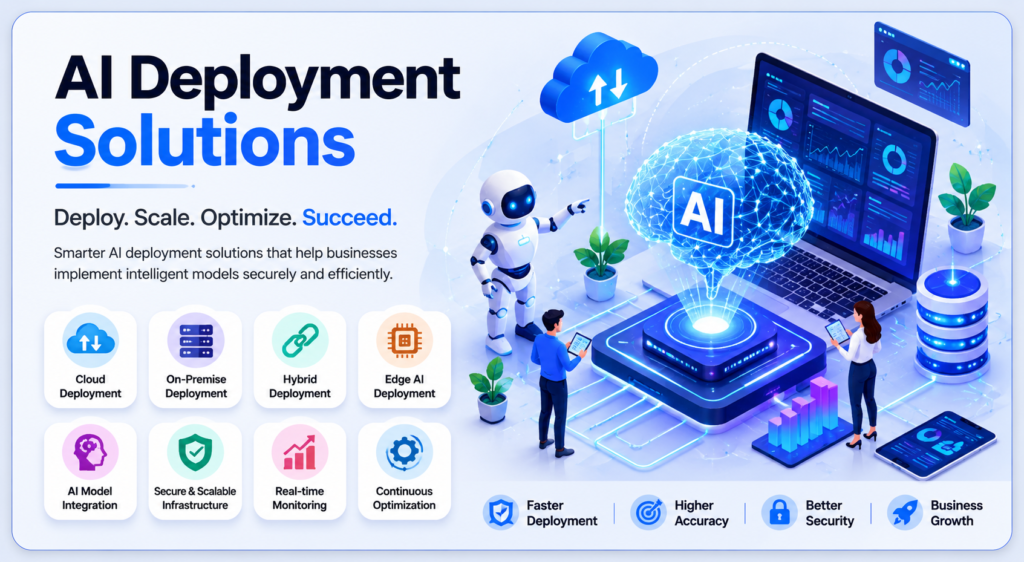
Cloud Deployment
Leveraging specialized public or private cloud environments via platforms like AWS, Google Cloud, or Microsoft
Azure. Cloud AI deployment provides
unparalleled scalability, letting you spin up vast computational resources instantly on a flexible pay-as-you-go
model.
On-Premise Deployment
For organizations operating under strict legal frameworks or managing highly confidential intellectual property,
running models on dedicated local servers is the preferred route. This affords complete control over data
security boundaries, though it demands heavy upfront capital expenditures for hardware.
Hybrid Deployment
Hybrid configurations balance security with operational agility. Sensitive customer data remains protected on
local corporate servers, while non-sensitive compute-heavy tasks are routed directly to public cloud
infrastructure for cost-efficient processing.
Edge AI Deployment
Deploying models directly onto physical endpoint hardware, such as smartphones, IoT industrial sensors, or
autonomous vehicles. This model eliminates data transit time, providing near-instantaneous offline inferences
with zero dependency on external network connectivity.
| Deployment Model | Latency Profile | Scalability | Upfront Capital Investment | Primary Benefit |
|---|---|---|---|---|
| Cloud AI Deployment | Variable (Network Dependent) | Extremely High | Minimal (OpEx) | Rapid Time-to-Market |
| On-Premise | Low (Local Network) | Limited by Hardware | Substantial (CapEx) | Maximum Data Privacy |
| Hybrid | Balanced | Highly Scalable | Moderate | Optimized Flexibility |
| Edge AI | Ultra-Low (Instantaneous) | Decentralized | Device-Dependent | Offline Functionality |
Benefits of Professional AI Deployment Services
Partnering with a dedicated engineering provider eliminates structural guesswork. Specialized AI deployment services accelerate
product development timelines, helping you bypass common engineering pitfalls. Experienced engineers optimize
models via quantization and pruning techniques, drastically reducing expensive monthly cloud resource
expenditures.
Furthermore, professional integration ensures your AI investments talk seamlessly with legacy internal CRMs, ERP
solutions, and transactional databases, unlocking instant process automation across your entire enterprise
workflow.
Common Challenges in AI Deployment
Even highly experienced software engineering teams encounter complex bottlenecks when implementing
production-grade machine learning. Understanding these roadblocks allows for preemptive planning:
- Model Drift and Degradation: Over time, real-world user behavior shifts away from the
historical data used during initial training, causing predictive accuracy to degrade naturally. - High Inference Latency: If a model takes several seconds to compute a response, it
breaks down consumer-facing applications, resulting in high bounce rates. - Resource & Cost Management: Unoptimized neural networks left running continuously
on high-end enterprise cloud GPUs can generate massive, unsustainable operational bills.
Step-by-Step AI Deployment Process
A reliable deployment follows a standardized engineering lifecycle designed to eliminate unexpected production
errors:
- Model Optimization & Serialization: Converting raw model files into optimized
cross-platform formats (such as ONNX or TensorRT) to maximize processing efficiency. - Containerization: Packaging the exact model binaries, dependencies, and environments
securely into isolated Docker containers to guarantee uniform performance across all server nodes. - Shadow & Canary Testing: Routing real production traffic to the new model in
“shadow mode” to verify stability and performance metrics before safely routing live user facing
decisions. - Continuous Monitoring & Logging: Implementing monitoring frameworks like Prometheus
and Grafana to track model accuracy, input data anomalies, and computational health around the clock.
Industry Use Cases
Healthcare & Diagnostics: Leading hospitals deploy deep learning vision models directly
into imaging hardware, surfacing potential radiological abnormalities to diagnostic doctors within seconds.
FinTech & Fraud Interception: Major global banking institutions route millions of
transaction strings through high-throughput machine learning deployment frameworks every
second, blocking fraudulent credit card activity instantly.
E-Commerce Hyper-Personalization: Enterprise retail giants implement cloud recommendation
engines that instantly re-rank digital storefront interfaces based on real-time consumer browsing
interactions.
How to Choose the Right AI Deployment Partner
Selecting an unseasoned technology vendor can introduce massive risk to your data pipelines. When vetting an
AI deployment company, meticulously review their case studies regarding system security
standards and high-availability engineering. Ask precise questions about their experience building custom MLOps
pipelines and managing complex cloud resource optimization to ensure your ongoing system maintenance remains
cost-efficient over the long run.
Future of AI Deployment Solutions
We are rapidly entering an era dominated by automated MLOps pipelines and hyper-distributed decentralized
intelligence. Future architectures will feature zero-touch deployment pipelines that automatically discover,
self-correct, and optimize model weights in production without human intervention. Furthermore, as edge hardware
processing chips continue to evolve rapidly, more computational workflows will shift away from expensive
centralized servers directly onto highly distributed consumer devices.
Conclusion
The true business value of artificial intelligence is realized the exact moment a model successfully processes
its first production workload. While establishing high-availability, secure, and fully scalable AI deployment solutions requires
upfront strategic investments, the long-term rewards in process automation and data-driven insights are
game-changing for modern enterprises.
Frequently Asked Questions
What are AI deployment solutions?
AI deployment solutions encompass the framework, tools, and processes required to integrate trained
machine learning models into a live production environment, enabling businesses to generate real-time
automated decisions.
How long does enterprise AI deployment take?
The timeline varies significantly depending on model complexity, data infrastructure readiness, and
security standards. Simple cloud deployments can take a few weeks, while complex enterprise AI
deployment projects might take three to six months.
Why should we choose hybrid AI deployment?
Hybrid AI deployment provides the ideal balance between security and scalability. It allows enterprises
to store sensitive data securely on-premise while leveraging cloud infrastructure for heavy
computational processing requirements.
What is the role of an AI deployment company?
An AI deployment company provides end-to-end consulting, architecture setup, model optimization,
security compliance, and maintenance services to smoothly transition AI concepts into real business
applications.
How do you ensure data security during AI integration?
Security is maintained using advanced encryption standard protocols (both at rest and in transit),
secure API gateways, strict identity and access management (IAM), and compliance audits like SOC2, GDPR,
or HIPAA.
Ready to Scale Your AI Infrastructure?
Stop leaving your valuable machine learning models trapped in experimental sandboxes. Partner with an
industry-leading AI deployment company to unlock secure, automated, and hyper-scalable AI integration built
precisely for your unique enterprise workflows.