Learn Machine Learning: A Complete Beginner’s Guide to Mastering ML in 2026
We are living in an era where data is the new oil, and artificial intelligence is the engine refining it. If you want to learn machine learning, 2026 is undoubtedly the most strategic time to start. From personalized streaming recommendations to self-driving cars, the algorithms operating quietly behind the scenes are reshaping how we interact with technology.
This guide is designed specifically as machine learning for beginners. Whether you are a student, a developer looking to upskill, or a business professional wanting to understand the data-driven landscape, this comprehensive post will provide you with the exact foundation you need.
The Basics: Understanding AI and Machine Learning
What is Machine Learning?
At its core, machine learning (ML) is a specialized subset of Artificial Intelligence (AI). Instead of explicitly programming a computer step-by-step to perform a task, machine learning involves training an algorithm using large amounts of data. The system recognizes patterns, learns from them, and makes informed decisions or predictions without human intervention.
How Machine Learning Works
The standard pipeline of machine learning involves four primary steps: gathering robust data, cleaning and preparing that data, training an algorithm to find underlying patterns, and finally, deploying the trained model to make predictions on new, unseen data.
Types of Machine Learning
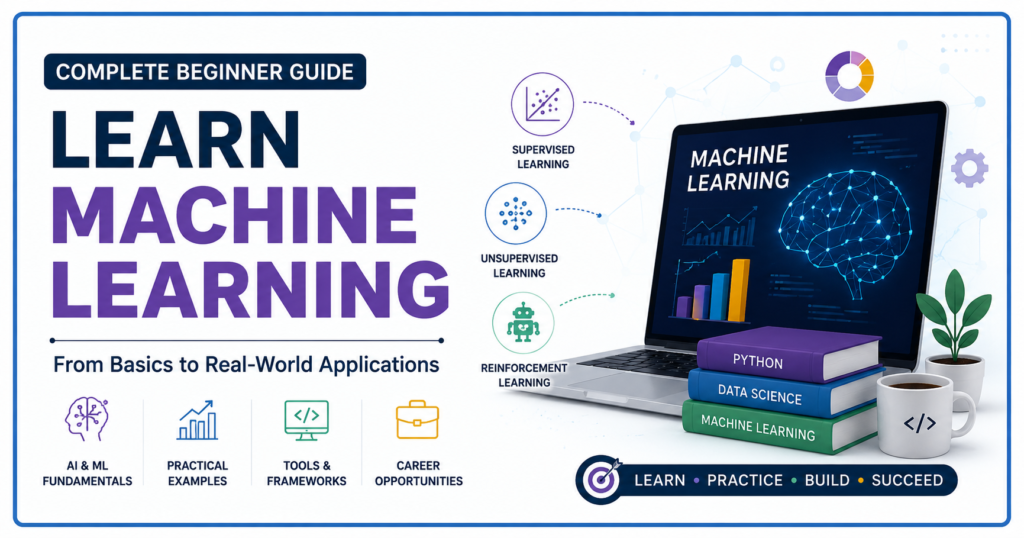
- Supervised Learning: The algorithm is trained on a labeled dataset, meaning the target answer is already known. It learns to map inputs to the correct output (e.g., predicting house prices based on historical sales data).
- Unsupervised Learning: The algorithm works with unlabeled data and tries to find hidden structures or groupings on its own (e.g., segmenting customers into different marketing personas based on purchasing behavior).
- Reinforcement Learning: The algorithm learns by trial and error in an interactive environment. It receives “rewards” for correct actions and “penalties” for wrong ones, optimizing its strategy over time (e.g., teaching an AI to play a complex strategy game).
Why Learn Machine Learning in 2026?
The digital landscape is shifting rapidly. The beauty of this technology is its unparalleled scalability. Today, we are seeing localized tech initiatives—such as an emerging AI services agency in Mohali—rapidly transition their operational focus to serve a worldwide audience. By mastering these algorithms, local solutions can instantly be deployed on a global scale, driving immense business value.
Learning ML ensures you are future-proofing your career. It empowers you to automate mundane tasks, derive deep insights from massive datasets, and build products that genuinely understand user intent. It is the definitive skill for modern innovation.
Essential Machine Learning Skills You Need
Before diving into neural networks, you need to build a solid foundation. The core machine learning skills revolve around a mix of programming and mathematical intuition.
1. Python Programming
Python is the undisputed king of AI. Its readable syntax and massive library ecosystem make it the mandatory first step.
2. Statistics & Mathematics
You don’t need a PhD, but understanding Linear Algebra, Calculus, and Probability is crucial to knowing how algorithms actually work under the hood.
3. Data Analysis
Proficiency in handling, cleaning, and visualizing data using tools like Pandas and SQL is a daily requirement for any ML practitioner.
Your 2026 Machine Learning Roadmap
Ready to start? Follow this structured machine learning roadmap to ensure you progress logically and effectively.
- Month 1-2: Master Python and Data Fundamentals. Focus on Python basics, loops, functions, and object-oriented programming. Move on to libraries like NumPy for numerical processing and Pandas for data manipulation.
- Month 3: Grasp the Math. Take time to study statistics, distributions, matrices, and basic calculus. This will demystify how models calculate error and optimize themselves.
- Month 4: Learn Core ML Algorithms. Dive into Scikit-learn. Understand linear regression, logistic regression, decision trees, and clustering techniques.
- Month 5: Deep Learning Basics. Once comfortable with standard ML, step into neural networks. Explore frameworks to build basic deep learning models.
- Month 6: Build and Deploy Projects. Theory is useless without practice. Create end-to-end projects, host them on GitHub, and deploy models using web frameworks like Flask or FastAPI.
💡 Pro Tip for Beginners:
Don’t get stuck in “tutorial hell.” The moment you finish a machine learning tutorial, try to apply that concept to a completely different dataset. Hands-on experimentation is where real learning happens.
Top Machine Learning Tools and Frameworks
You don’t need to build algorithms from scratch. The open-source community provides powerful tools. If you choose to learn machine learning online, you will frequently encounter these staples:
- Python: The foundational language powering most AI infrastructure.
- Scikit-learn: The best library for traditional supervised and unsupervised learning algorithms.
- TensorFlow & PyTorch: The industry-standard heavyweights for deep learning and neural networks. (PyTorch has become particularly favored in research and modern production).
- Jupyter Notebook: An interactive web-based environment that allows you to combine code execution, rich text, and data visualizations in a single document.
Real-World Applications of Machine Learning
Understanding the theory is great, but seeing it in action validates its power. Here is how various industries are being disrupted:
- Healthcare: Predicting patient readmissions, discovering new pharmaceutical compounds, and using image recognition to detect anomalies in X-rays and MRI scans.
- Finance: Algorithmic trading, real-time credit scoring, and sophisticated fraud detection systems that analyze millions of transactions per second.
- Retail & E-commerce: Dynamic pricing models, automated inventory management, and hyper-personalized product recommendation engines.
- Marketing: Predictive analytics for customer churn, automated content generation, and optimizing SEO strategies based on search engine algorithm updates.
Launching Your Machine Learning Career
A machine learning career is highly rewarding, both intellectually and financially. Depending on your specific interests, you can aim for several distinct roles:
- Data Scientist: Focuses on extracting actionable insights from complex data sets using statistical methods and ML models.
- Machine Learning Engineer: Focuses on the software engineering aspect—taking data science models and scaling them for robust, production-level environments.
- AI Consultant: Bridges the gap between technical teams and business stakeholders, strategizing how AI can solve specific business bottlenecks.
Start Your Journey Today
Machine learning is no longer just a futuristic concept; it is the present reality driving global digital transformation. Whether you are aiming to build the next big tech startup or secure a top-tier role in a Fortune 500 company, the time to act is now.
Explore Machine Learning Courses
Join thousands of students and professionals building practical projects and staying updated with the latest AI trends.
Frequently Asked Questions (FAQs)
1. Can I learn machine learning without a coding background?
Yes, while a coding background helps, beginners can start with foundational Python and utilize user-friendly platforms and libraries. Taking a dedicated machine learning course tailored for complete beginners will bridge the technical gap over time.
2. How long does it take to learn machine learning?
For a beginner dedicating 10-15 hours a week, it typically takes 6 to 8 months to grasp the fundamentals, become proficient in Python, and build a portfolio of basic to intermediate ML projects.
3. What is the best programming language for machine learning?
Python is universally considered the best programming language for machine learning due to its simple syntax, massive community support, and powerful frameworks like TensorFlow, PyTorch, and Scikit-learn.
4. Is machine learning a good career in 2026?
Absolutely. The demand for AI and machine learning professionals continues to skyrocket across all industries, offering lucrative salaries, high job security, and the chance to work on cutting-edge technological advancements.
5. What is the difference between AI and machine learning?
Artificial Intelligence (AI) is the broader concept of machines being able to carry out tasks in a smart way, whereas machine learning is a specific application of AI based on the idea that we should give machines access to data and let them learn for themselves.